
Australian research shows people with intellectual disability are 3 times more likely to experience serious mental illness
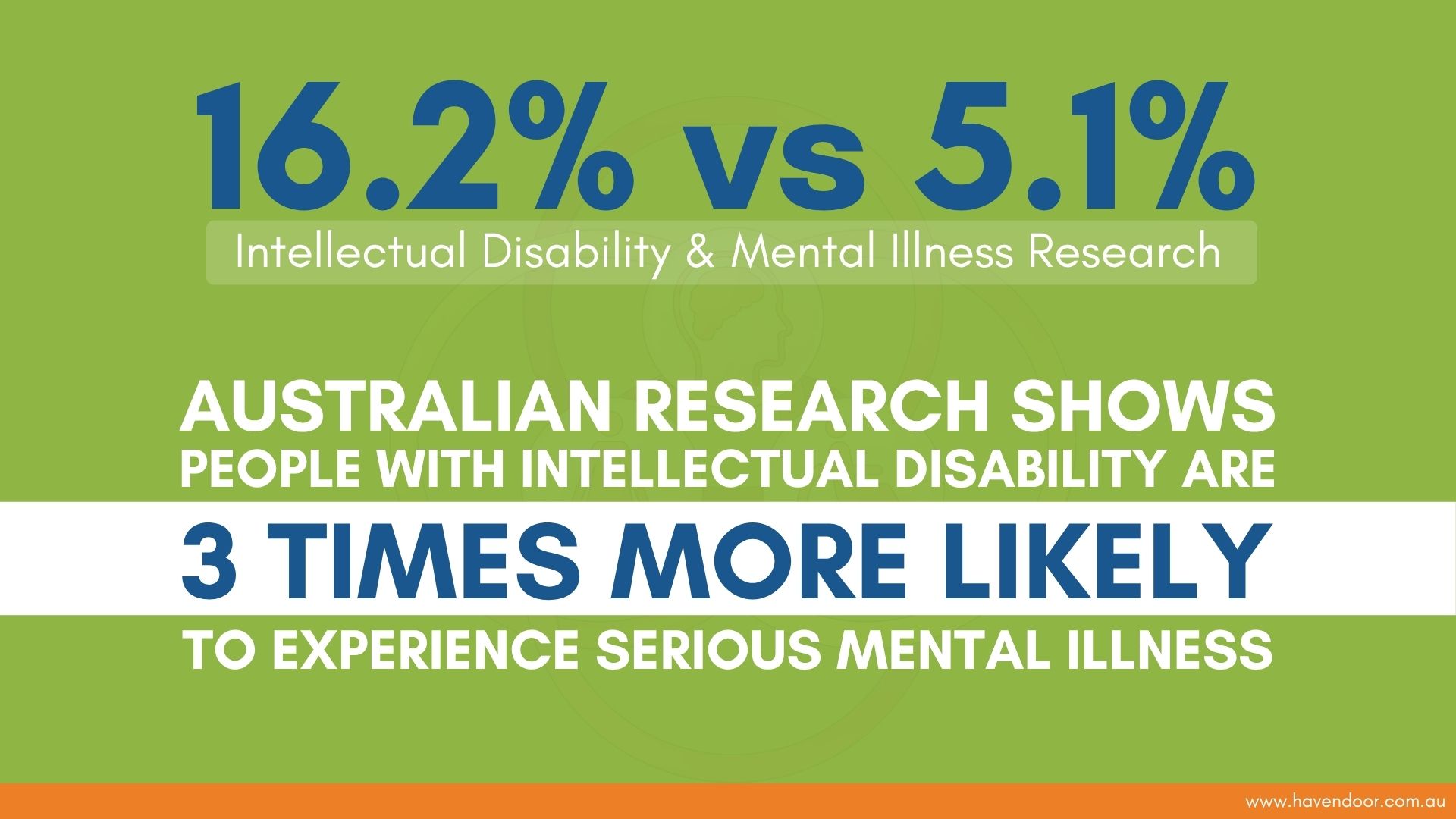
A study of close to 100,000 people with intellectual disability in New South Wales found that 16.2% experienced a serious mental illness, compared with 5.1% of a matched group of people without intellectual disability.
The research was published in the Australian & New Zealand Journal of Psychiatry by a team at UNSW Sydney (Arnold et al., 2025). It followed the cohort across 17 years and is one of the largest studies of its kind conducted anywhere.
The figures below are drawn from that study and from two others, and are set out here for those involved in NDIS support including participants, families, support coordinators and providers.
We encourage everyone to be mindful that mental health conditions can be masked by disability, and symptoms are sometimes incorrectly attributed to the person's disability.
What the study counted
Serious mental illness was defined narrowly in this research. A person was counted only if their mental illness was severe enough to result in a hospital admission or care from specialist mental health services, so the 16.2% describes the more severe end of mental illness rather than every person with intellectual disability who experiences it. Importantly, the study therefore does not cover people who may have had a mental health issue but did not interact with a mental health service.
Variations by condition
The study compared the two groups across the 17 years to 2018 and found higher prevalence in people withintellectual disability for every condition it examined.
| Condition | Intellectual disability | Comparison group | Prevalence (roughly) |
|---|---|---|---|
| Serious mental illness | 16.2% | 5.1% | 3 times |
| Psychotic disorders | 8.2% | 1.2% | 7 times |
| Mood or affective disorders | 11.1% | 5.3% | 2 times |
| Depression | 10.0% | 5.1% | 2 times |
| Bipolar disorder | 2.6% | 0.6% | 4 times |
| Anxiety disorders | 9.2% | 4.0% | 2 times |
| Substance use disorders | 7.6% | 4.7% | 1.5 times |
| Intentional self-injury or suicidality | 6.7% | 2.8% | 2 times |
| Non-dementia organic disorders | 5.3% | 1.5% | 3.5 times |
| Personality disorders | 4.0% | 1.0% | 4 times |
| Dementia | 2.7% | 0.6% | 4.5 times |
Psychotic disorders showed the widest gap of any condition measured, occurring at close to 7 times the rate.
Depression and anxiety, the two conditions most people are familiar with, each occurred at roughly twice the
rate.
Risk is not spread evenly
The overall figures conceal a wide range underneath them. An Australian meta-analysis of more than 4,000 children with genetic syndromes associated with intellectual disability found that the proportion showing clinically significant psychiatric symptoms differed substantially from one syndrome to the next, with Down syndrome at the lower end of that range and Prader-Willi syndrome at the upper end (Glasson et al., 2020). Every syndrome the review examined sat above general population rates.
Risk also varies with what else a person lives with. In the New South Wales data, people with a co-occurring attention or learning disorder experienced serious mental illness at a markedly higher rate than the intellectual disability cohort as a whole.
The practical implication runs in both directions. For some people the risk sits considerably higher than the headline figure suggests, and for others it sits lower, which is why no individual should be read as a statistic.
Living inside a major centre
A companion study from the same research centre followed more than 47,000 people with intellectual disability in New South Wales aged 13 to 80, and examined which factors were associated with a person going on to develop a mental illness (Michalski et al., 2025).
Living in an outer regional, remote or very remote area was associated with the onset of serious mental illness, alongside co-occurring ADHD, a learning disorder, being male, and having a previous history of mental illness. The factors associated with the onset of any mental illness were somewhat different, and included ADHD, learning disorders, physical health conditions, and living in an area of greater socio economic disadvantage.
What this can look like day to day
Population figures do not tell anyone what to look for in a particular person, and mental illness in someone with intellectual disability does not always present the way it does in the general population. Where a person communicates with few or no words, a change in behaviour or in day-to-day functioning may be the clearest indication that something is wrong.
What tends to be more informative than any single behaviour is a change from the person's own baseline. Since what is ordinary for one person is not ordinary for another, the more useful question is what has shifted recently and when it started. Changes in sleep or appetite, withdrawal from activities the person normally enjoys, the loss of a skill they previously had, and new or increased distress are all worth taking seriously.
When something does change, it is often attributed to the person's disability. That assumption can mask what is actually driving the change and delay support that would otherwise help. Recognising a change of this kind depends on knowing what is usual for the person in the first place, which is why the people who see someone regularly are often the first to notice that something is different. It is the pattern HavenDoor's Mental Health Nurses look for from the first meeting, which is less a list of behaviours than a picture of what has changed for a particular person and when.
A note on these figures
Selected figures have been drawn from the studies below rather than the studies being summarised here. Prevalence figures in this field vary depending on how mental illness is defined and how people are identified, and each study carries its own methods and limitations, which the authors set out in the papers themselves. All three studies are peer-reviewed and Australian, and the two New South Wales studies are open access and worth reading in full if you have the time.
If any of this is familiar from your own experience of supporting someone, or from your own life, the person to raise it with is their GP or treating clinician, or your own. HavenDoor's supports are overseen by Mental Health Nurses, but we are not your treating team, and no article can assess an individual situation.
If someone is in immediate danger, call 000. Lifeline is available on 13 11 14 and Beyond Blue on 1300 22 4636.
Sources
Arnold SRC, Huang Y, Srasuebkul P, Cvejic RC, Michalski SC, Trollor JN (2025). Prevalence of psychiatric conditions in people with intellectual disability: A record linkage study in New South Wales, Australia. Australian & New Zealand Journal of Psychiatry, 59(5), 433 to 447. Open access:
https://doi.org/10.1177/00048674251324824
Michalski SC, Huang Y, Srasuebkul P, Cvejic RC, Arnold SRC, Trollor JN (2025). Predictors of mental illness onset in adolescents and adults with intellectual disability: A retrospective cohort study in New South Wales, Australia.
Australian & New Zealand Journal of Psychiatry. Open access:
https://doi.org/10.1177/00048674251374483
Glasson EJ, Buckley N, Chen W, et al. (2020). Systematic review and meta-analysis: Mental health in children with neurogenetic disorders associated with intellectual disability.
Journal of the American Academy of Child & Adolescent Psychiatry, 59(9), 1036 to 1048.
https://doi.org/10.1016/j.jaac.2020.01.006
Latest Posts