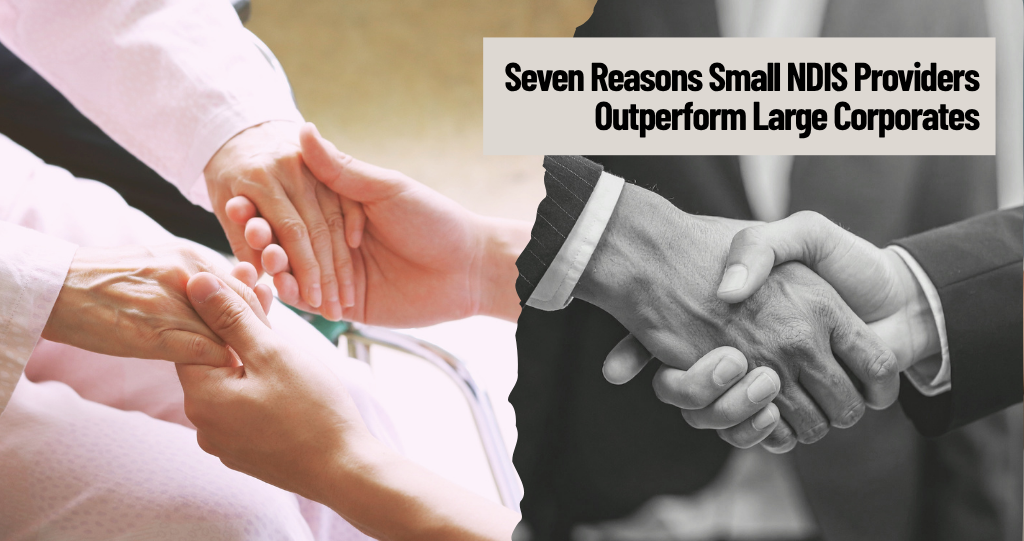
Seven Reasons Small NDIS Providers Outperform Large Corporates
For many NDIS participants and families, choosing the right provider is one of the most consequential decisions they will ever make. It shapes not only the quality of support they receive, but also their sense of safety, dignity, and possibility.
Large corporate providers with their glossy brochures, long service lists, and national footprints, often appear to be the “safe” choice. But in practice, bigger is not always better. In fact, for many participants, a small specialist provider offers a level of care, responsiveness, and human connection that large
organisations simply cannot replicate.
Let’s we explore why.
1. Personalised Support That Isn’t Lost in the System
Large providers are built for scale. Their systems, staffing models, and processes are designed to manage thousands of participants across multiple service streams. While this can create efficiency, it also creates distance.
Small specialist providers, by contrast, are built around relationships.They know their participants by name, not by NDIS number. They understand the nuances of a person’s routines, triggers, preferences, and goals because they are close enough to notice them.
In the NDIS context, this matters.
The Scheme is built on the principle of reasonable and necessary supports tailored to the individual. But tailoring requires time, attention, and continuity – three things that smaller providers are naturally better positioned to deliver.
For example, HavenDoor’s mental-health-informed model allows its team to understand the subtle shifts in a participant’s wellbeing that larger providers often miss. This depth of attunement is especially important for people with hidden mental health challenges, where
early recognition of changes can prevent escalation.
2. Faster Decisions and Less Bureaucracy
Anyone who has interacted with a large NDIS provider knows the experience:
emails routed through generic inboxes, phone calls answered by people who don’t know your situation, and decisions that require multiple internal sign-offs.
This isn’t because large providers don’t care. It’s because they are built like corporations – hierarchical, process-heavy, and risk-averse.
Small specialist providers operate differently.
Their decision-makers are usually close to the frontline, and often directly involved in service delivery. This means:
- quicker onboarding
- faster responses to concerns
- more flexible rostering
- real-time problem-solving
- direct access to leadership when needed
For participants with complex needs – especially in SIL, or behaviour support – timeliness is essential. HavenDoor, for instance, is known for its ability to make clinical observations and program adjustments quickly because its leadership team includes experienced mental health nurses who remain actively involved in day-to-day operations. This reduces delays, prevents crises, and creates a more stable support environment.
3. Consistency of Staff and Genuine Human Connection
One of the most common frustrations participants express about large providers is staff turnover. Big organisations often rely on large casual workforces, rotating rosters, and internal transfers. Participants may see a new face every week, or even every shift.
Small specialist providers tend to build smaller, more stable teams.They recruit intentionally, matching staff to participants based on personality, skills, and values – not just availability. They invest in relationships because they understand that trust is the foundation of effective support.
In the NDIS, consistency is not just emotionally comforting – it is clinically important.For participants with autism, psychosocial disabilities, trauma histories, or cognitive impairments, predictable relationships reduce anxiety, improve communication, and support long-term progress.
Support workers reporting directly to experienced clinicians creates a level of continuity and clinical oversight that large providers struggle to replicate. This structure ensures staff remain connected, supported, and aligned with participant wellbeing goals.
4. Deep Expertise in a Specific Area – Not a Jack-of-All-Trades Approach
Large providers often offer dozens of service types: aged care, SIL, community access, therapy, plan management, support coordination, employment services, and more. While this breadth is occasionally convenient, it can dilute expertise.
Small specialist providers typically focus on a narrow set of supports – often the ones they are genuinely passionate about and highly skilled in.
This means senior management are involved in:
- providing depth of expertise
- understanding participant needs
- program design
- risk management
- training staff
In other words, in small specialist providers the people with all the experience (senior management) are NOT just looking at financial results! They are involved in outcomes.
In the NDIS, where quality varies widely, specialist knowledge is a major advantage. Participants benefit from providers who do a few things exceptionally well, rather than many things at a surface level.
5. A Culture of Care, Not a Culture of Compliance
Large providers must prioritise compliance – because the scale of their operations demands it. But sometimes, compliance becomes the culture. Staff become focused on forms, checklists, and KPIs rather than the human being in front of them.
Small providers, while still bound by the same NDIS Quality & Safeguards Commission standards, often operate with a different ethos.
Their culture is usually shaped by founders or leaders who entered the sector for personal, values-driven reasons. This creates environments where:
- empathy is visible
- staff feel connected to purpose
- participants feel genuinely cared for
- decisions are guided by humanity, not bureaucracy
This emotional climate matters. Participants can feel the difference between being supported by a team that sees them as a person versus a system that sees them as a case file.
6. Greater Accountability and Transparency
In a large organisation, responsibility is diffuse. When something goes wrong, it can be difficult to identify who is accountable. Complaints may be escalated through multiple layers, and participants can feel powerless.
Small specialist providers operate with clear lines of accountability.
If a participant or family member raises a concern, they can speak directly to someone who has the authority to fix it. Leadership is visible, accessible, and invested in outcomes.
This transparency builds trust.
Participants know who is responsible for their wellbeing, and providers know they are personally accountable for the quality of their service.
7. The Emotional Safety of Being Known
Perhaps the most profound difference is also the simplest:
In a small provider, participants feel known.
Not just their goals.
Not just their diagnoses.
But them – their humour, their fears, their quirks, their hopes.
This emotional safety is transformative.
When participants feel seen and valued, they engage more deeply in their supports. They try new things, step outside their comfort zone, and build confidence. They feel less like clients and more like partners in shaping their lives.
In a system as complex and often overwhelming as the NDIS, this sense of belonging is priceless.
Latest Posts