
Doing With, Not For: Helping Participants Use the Capacity They Have

A participant moves into Supported Independent Living able to make a simple breakfast, manage part of their morning routine, and pick out their own clothes. Six months on, a support worker is quietly doing all three. Nobody decided this. It happened one helpful moment at a time – toast made because the morning was running late, a shirt chosen because it was quicker.
This slow drift is one of the most common, and most preventable, problems in disability support. It rarely appears in an incident report. But it shows up in a participant's life as a steady narrowing of what they do for themselves – and reversing it is one of the clearest markers of support that is working.
The helpfulness trap
Most over-support comes from kindness, not neglect. Doing a task for someone is faster, smoother, and feels caring in the moment. A worker who steps in is being helpful – and that is exactly the trap. Each small rescue teaches a quiet lesson: this is something other people do for me. Over months, a participant can lose not the ability itself but the expectation that the ability is theirs to use.
The shift good support workers make is from
doer
to
coach. The job is not to complete the task. It is to make sure the participant does as much of it as they can.
"Can't" and "hasn't yet" are different things
When a participant doesn't do something, it is worth pausing on why. Sometimes it is genuine inability – and support should fill that gap without hesitation. Often, though, it is something else: anxiety about getting it wrong, the executive-function hurdle that makes a first step feel impossible, low confidence after years of being managed, or a stress response that has little to do with the task in front of them.
These look identical from the outside. A participant who stops at the kitchen bench and one who genuinely cannot manage the bench present the same way – not doing the task. Telling them apart is a skill, not a guess. At HavenDoor, where support is led by mental health nurses, reading what sits underneath a behaviour – and responding to that rather than to the surface – is core to how the team works. A participant who "won't" cook dinner may be managing anxiety, not refusing. And the response to anxiety is not more prompting. It is less pressure, more predictability, and a smaller first step.
Just enough support
The working principle is simple to say and harder to practise:
give the least help that still allows success. Not so much that the participant becomes a spectator. Not so little that they are overwhelmed. Just enough.
In practice, that looks like:
- Wait longer than feels comfortable. Most of us step in after two or three seconds of silence. A participant often needs ten or fifteen to organise a thought and begin. That pause is not awkwardness – it is room to act.
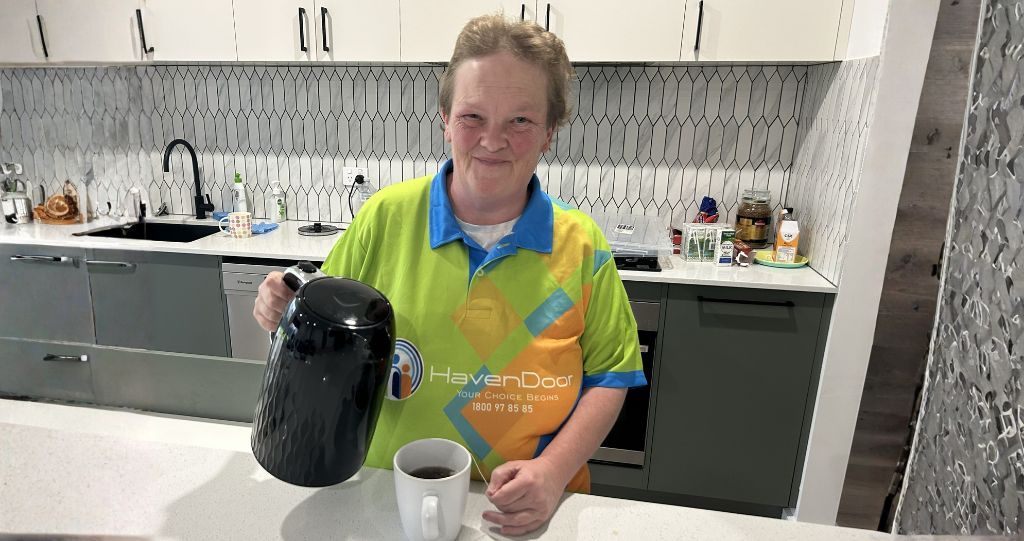
- Prompt before doing. A glance toward the kettle, then a gesture, then a few quiet words – each is lighter than putting your own hands on the task. Use the lightest prompt that works, and use it less over time.
- Hand back the steps they own.
Break an activity into parts. Walk to the café together, and let the participant order and pay. Carry the first few steps of a recipe, and let them finish. Finishing a task is what builds the feeling of having done it.
The same logic applies out in the community. Ordering their own coffee, counting out money at the shop, choosing where to sit – these are not small talk fillers in a Community Participation shift. They are the shift.
Confidence usually comes before skill
For many participants the barrier is not the task but the belief that they will fail at it. That is why how a worker responds to a shaky attempt matters more than the attempt itself. Notice the effort, not only the outcome – "you worked that out yourself" lands differently from "good job." Let small mistakes stand where they are safe; a slightly uneven sandwich made independently is worth more than a perfect one made by someone else.
And when a participant pushes back – "you do it" – curiosity works better than insistence. Resistance is information. It usually points to fear, fatigue, or a step that is simply too big, not to defiance.
Making it deliberate, not accidental
None of this holds as one worker's private style. Capacity-building works when the whole team supports the same way – and when families, who so often do the most out of love, are brought along too. It needs to be written down: what a participant did independently, what support was needed, what worked. That record is how progress becomes visible, and how the next shift continues rather than quietly resets. In a smaller, clinically led team, those patterns get noticed early – before drift becomes the norm.
Done well, support of this kind is not improvised. It is observed, recorded, and adjusted. A participant using more of their own capacity is not doing more chores; they are living a fuller, more self-directed life. That is the quiet outcome good support is for.
If you're weighing a placement and would like to think through how a particular participant might be supported to build capacity safely, the
HavenDoor team is glad to have an informal conversation – no obligation, just a chance to talk it through with people who do this every day.
Latest Posts